The TradeWings Institute of Management
Circa 2002-2011
This was the Trade Wings Institute of Management website for a number of years. The content below is from the site's 2002-2011 archived pages.
Welcome to Trade Wings Institute of Management (TIM), India's premier educational institute which launches young men and women into the exciting world of travel, tourism and hospitality. Come aboard, and let TIM give you wings!
Trade Wings Institute of Management is pomoted by Trade Wings Limited, one of the pioneers in Indian travel and tourism, TIM trains you with the collective experience and professional know how of over six decades.
The promoters, Trade Wings Limited, are one of the largest travel agencies in India with offices countrywide. In addition they own and operate a prestigious 5 star hotel and restaurant. The group also operates a cargo and courier service. The students of TIM have the unique opportunity of in house interface with all facets of travel and tourism industry.
TIM reaches out to students in almost all the states of India, with high industry-standard education. In response to the requirements of the travel and tourism in Nepal, TIM has also set up a centre at Kathmandu.
TIM has 9 IATA authorised training centres in India qualified and authorised to teach students for the IATA/UFTAA examination held from Montreal, Canada. It also has an exclusive tie-up with Galelio, one of the world's leading reservation systems, to impart quality training.
Because of its position in the industry, TIM is able to give students first person accounts of what's happening out there. Even before a course is through, employers approach TIM for profiles of the brightest students!
Academically progressive, intellectually exciting!
- The courses are drawn up by professionals, to make you a professional.
- The coverage is vast and exciting.
- A great deal of emphasis is on innovative ability and extra customer delivered value.
- All the courses are technology and customer driven, keeping in mind rapidly changing work environments and cultures.
- They suit the students' time and budget.
- And, they are recognised in India and abroad.
The recognition ensure immediate placement. More than 15,000 students of TIM are today in the forefront of the industry at all levels. There can be no better testimony to the value of a TIM certificate.
At a time when you think the cost of travel is rising, what's really hitting the skies is tourist traffic, business traffic, students criss-crossing the globe!!! Nobody stays in one place anymore.
The world is a much busier place, and getting busier by the hour... Figure it out before you jump aboard!
- The tourism & travel industry is the world's number-one industry, contributing to 10% of the world's economy!
- Tourism is not just one industry, it is many industries in one.
- Worldwide travel and tourism create a new job every 10 seconds.
- Out of every nine persons, one person earns a living from tourism
- One out of every ten inhabitants of this planet is a tourist
- Travel is expected to grow 50 percent faster than any other sector of world employment.
ABOUT Trade Wings Institute of Management
Good faculty is the most important and decisive feature of any training institute. The faculty at TIM are professionals with meritorious track records and years of hands-on experience in their chosen fields.
Visiting faculty
The institute invites leading and experienced persons from different sectors of travel, hotel and cargo industry to ensure students get the best possible exposure to the industry.
TIM faculty come from a variety of backgrounds...
- Business administration
- Hotel management
- Travel and ticketing
- Airline management
- Cargo administration
- Education
- Tourism
As a former teacher brought on by Trade Wings Institute of Management to test whether computer science courses would attract interest, my experience was… complicated. I wasn’t hired as a developer, but as a coder with an academic background, I naturally interfaced with the team maintaining their website and internal systems. That’s when I discovered they were still relying on FileMaker Pro — an unsupported software package that had long since fallen out of favor and was clearly causing compatibility headaches when paired with newer tools and systems.
I flagged the issue early on and pushed for the adoption of a more modern replacement for Filemaker. Unfortunately, that advocacy was not welcomed. Despite the Institute’s promotional claims of being “technologically advanced” and using “multimedia teaching methods,” the underlying infrastructure told a very different story. My concerns were seen as overstepping, even though the dysfunctions were evident — slow system performance, data syncing issues, and limited integration options with industry-standard platforms. The tension only grew, and eventually, it became clear that the Institute wasn’t ready to evolve beyond its legacy tools. So I left. My departure wasn’t because I didn’t believe in the mission of the school — I did. But no coder wants to spend their time fighting for basic upgrades while trying to teach forward-looking tech to students who deserve better. Danielle Morgan
TIM courses offer you many career options. Select your course keeping in mind your objectives, your interests and your aptitude. (The latter is very important!)

Diplomas, specialisations and combos
TIM courses are available in different modules to assist students zero into their interests. The modular structures have also been based on feedback from the industry on the many skills and qualification necessary for freshers and existing staff.
The Magnum Diploma courses make it possible for more ambitious students to wrap up greater knowledge and skills in a single course.
Get your company to sponsor you
Many students who enrol, particularly in the IATA/UFTAA training, the SABRE CRS, Basic Fares and Ticketing and Tourism on the Net, are people already working in the industry, but wanting to build up their careers.
Most companies are supportive of employees wanting to improve their performance and are willing to bear the training cost.
Earn and learn
Students with inititative find it possible to do part-time work alongwith the courses. While the courses are full-fledged diploma studies and do require considerable time and attention, agile youngsters seem to accomplish earning and learning with great facility!
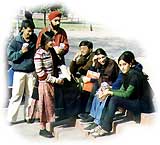 When you enter the classroom, expect a bunch of girls and boys who are as interested as you are in the travel and tourism trade!
|
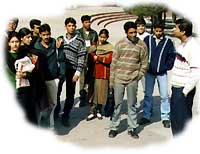 The faculty at TIM are professionals with meritorious track records and years of experience in their specialisations. What makes them distinctive is their passion for their subject.
|
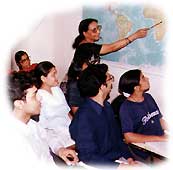 Lectures will be peppered with debates, discussions and seminars. Be prepared to lead occasionally! To turn you into thorough professionals, you will be asked to conduct field investigations, case studies and other project work.
|
|||||
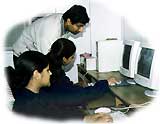 Computer aided training via CD-ROMs adds to making the classroom interactive, informative and as techie as you like it!
|
 Expect to have great interaction with your fellow students in the classroom and outside! TIM generally draws students with exuberant, extroverted personalities. And since each batch is a comfortable number of 20 - 25 students, you get to be a happy close-knit community. We find that a TIM course also does a good bit for the individual's personality development. |
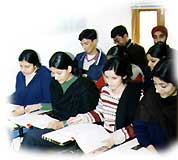 Expect guest lectures from luminaries in the travel, hotel and cargo industry. High profile managers, customer relations and marketing experts. |


 |
Expect to get great value for money. This is important for whoever is paying for the course fee - you, your parents or your organisation. TIM is the only institute of its kind in the country with such extraordinary depth and breadth of experience in the industry. |
+++++
Registration & enrolment
The registration and enrollment is not transferable. Registration and enrollment fees be paid in full when the application is made and must be accompanied with the application form which is attached with the prospectus. Fees once paid is not refunded.
Eligibility
In order to join TIM's diploma courses, the applicant should have successfully completed a higher secondary school or an equivalent education. A good understanding of written English, World Geography and Basic Mathematics is essential.
Registration procedure
The applicant should complete the attached registration form in BLOCK LETTERS indicating the course they wish to join. On completion of the registration formalities, the applicant will be entitled to the Course Material.
Enrolment procedure
Once the registration formalities are completed, the applicant should then fill in the enrollment form giving the complete details along with 3 passport size photographs . The enrollment fees will include complete course material for the course enrolled and two examination attempts per paper.
After enrollment the applicant will initially receive the compulsory module book - "Customer Relations and Marketing Skills". Subsequently, the applicant will receive the respective student material depending upon the course chosen.
Rules & Regulations
Students should attend classes regularly in order to derive full benefit from the course. Students will have to attend at least 75% of the classes in order to qualify for receiving their Diploma Certificate. Students are required to take prior permission in writing or submit an attested leave certificate for the days absent.
Batch timing
Even though the batch time will be specified, students will be required to attend practicals and guest lectures at a different venue and timings. However all efforts will be made to organize practicals during the announced batch time.
Students are expected to arrive 10 minutes before the commencement of the session. In case they are late by more than 20 minutes they will not be allowed to attend the session.
Transfers
Transfers are available from one center to the other in case the student is compelled to relocate. Transfers are permitted only after the completion of module. The admittance / admission at the new location would be from the beginning of the next module. In case of transfers, the receiving center would try to accommodate the student in the desired time slot but the same would be subject to availability and cannot be guaranteed. In case of transfer, a student should pay a fees of Rs 250/- to the Head Office-Mumbai, along with transfer request form.
Validity
Registration is valid upto 6 months from the date of completion of the course. The examination papers have to be cleared within this period. Students having pending term beyond this validity period will have to seek re-admission if they desire to complete the course.
+++++
Examination procedure
Students who enroll for TIM's diploma courses have to pass written examination. However the assessment of the students will be conducted on a continuous basis, giving due weightage to class participation, reports and projects.
When a student is unable to appear in a scheduled internal evaluation test or complete project reports due to illness or emergency, a written application should be given to the Branch Manager within 7 days of the examination. For a re-test, the Branch Manager on verification of the application will decide whether it should be granted or not.
Grading system
For the evaluation purposes, a 6 point grade system will be used. The grade and its corresponding percentages are shown below:
O OUTSTANDING 75-100
A VERY GOOD 65-74
B GOOD 55-64
C+ AVERAGE 50-54
Certification
All enrollments are deemed cancelled and complete on issue of the Diploma Certificate. For issuance of duplicate certificate, a fee of Rs 150/- would be charged. You will be awarded a Diploma, like the one shown here:
My neighbor here in Baltimore graduated from the Trade Wings Institute of Management. She was a great resource whenever I was planning to do something in Washington DC. She worked as a concierge at the Four Seasons Hotel and knew all the tricks to get hard to find tickets etc. Then she decided to move to Washington DC after landing a plum of a job at the Four Seasons located on the edge of Rock Creek Park in D.C.'s chic Georgetown neighborhood. I didn't realize until she told me that every concierge at the hotel is a member of Les Clefs d'Or, the prestigious concierge organization with just 3,000 members worldwide. Wow, little did I know. She is one classy person to have as a friend.
More Background On TradeWingInstitute.com
TradeWingInstitute.com is associated with the history of Trade Wings Institute of Management (TIM), an Indian professional education institution specializing in travel, tourism, aviation, hospitality, cargo management, and logistics. Established in 1989, TIM emerged from the extensive travel industry experience of Trade Wings Limited, a company whose origins date to 1949. The institute became known for providing career-oriented training designed to prepare students for employment in travel agencies, airlines, hotels, tourism companies, and other businesses involved in moving people and goods around the world.
The history of TradeWingInstitute.com is particularly interesting because it reflects an important period in the development of India's travel and tourism education sector. During the 1990s and 2000s, increasing international travel, airline competition, computerized reservation systems, and expanding hospitality businesses created demand for workers with specialized qualifications. TIM responded by developing professional diploma programs, establishing training centers across India, and building relationships with international industry organizations. Its educational model emphasized practical knowledge, industry experience, and professional certifications rather than relying exclusively on conventional academic instruction.
Although TradeWingInstitute.com preserves information associated with an earlier generation of the institute's educational activities, the broader Trade Wings educational organization has maintained an online presence through other websites, including TIMIndia.com, TradewingsEdu.com, and TradeWingsTravelInstitute.com. These resources provide additional historical information about the institute, its training programs, professional recognition, and transition toward online education. Understanding the distinction between the historical website and these related platforms is important because the institution's operations, ownership arrangements, training locations, and course offerings have evolved over time.
The Origins of Trade Wings Institute of Management
Trade Wings Institute of Management was established in 1989 to address a growing need for technically trained professionals in India's aviation, travel, tourism, and hospitality industries. Its creation was closely connected to Trade Wings Limited, a longstanding Indian travel services organization founded in 1949. By the time TIM was established, the parent business had accumulated decades of experience dealing with international travelers, airline reservations, tourism operations, and related commercial services. This industry background provided a foundation for developing an educational institution whose programs would reflect the actual requirements of employers.
Trade Wings Limited operated in several complementary business sectors, including corporate travel management, tourism services, foreign exchange, cargo handling, hospitality, and other travel-related activities. The organization also developed associations with international businesses, including American Express in corporate travel services. Its hospitality interests included Bogmallo Beach Resort in Goa, while its broader operations encompassed travel agency services, cargo activities, and financial services connected with international travel. These businesses gave the Trade Wings organization practical exposure to the various career paths that students at TIM might eventually pursue.
The decision to establish a training institute reflected an important change in the Indian employment market. Travel agencies increasingly needed employees who understood international airline ticketing procedures, fare construction, passenger documentation, reservation technology, and customer service. Hotels required trained personnel capable of serving international guests, while cargo operators needed workers familiar with documentation, regulations, and shipment procedures. TIM sought to bring these different professional disciplines together under a structured educational framework.
Rather than concentrating on a single occupation, the institute developed programs covering multiple segments of the travel economy. This approach was particularly relevant because many of these industries share common operational requirements. Airline ticketing personnel, hotel employees, tour operators, and cargo specialists all need strong communication skills, organizational abilities, technological competence, and an understanding of international business practices. By combining specialized training with broader professional development, TIM positioned itself as a pathway into several interconnected industries.

Ownership, Management, and Corporate Connections
The original Trade Wings Institute of Management was promoted by Trade Wings Limited, and its educational identity was closely associated with the parent company's reputation in Indian travel services. Historical institutional materials describe TIM as part of the Trade Wings business network, emphasizing the advantages of learning from an organization with substantial practical experience. This relationship was an important element of the institute's marketing because it distinguished TIM from training providers without comparable industry connections.
The institute's later development involved additional organizational structures and online education initiatives. TradewingsEdu.com, launched in January 2017, described itself as an associate of the Mumbai-based Trade Wings group and identified TIM as the institution behind its educational concept. More recently, TradeWingsTravelInstitute.com has identified Narayani Hospitality and Academic Institution Pvt. Ltd. as the company operating its online educational platform while carrying forward the academic legacy of TIM. These descriptions indicate continuity in educational branding and subject matter, although they should not be interpreted as evidence that every historical and present-day entity has an identical ownership structure.
Individuals associated with TIM's documented activities include Rajan Dani, identified as a director when the institute received international training recognition in 2011. The TradewingsEdu platform has also identified Vikrant Argade as Creative Director, Kalpana Kulkarni as Specialist Content Developer and Training Coordinator, and Ameya Murudkar as IT Head. These names help illustrate the organizational responsibilities involved in developing training materials, managing educational technology, and supporting specialized instruction.
For anyone researching TradeWingInstitute.com from a corporate or historical perspective, the distinction between the original educational institution, its parent travel company, and subsequent online learning businesses is significant. The historical website documents an earlier educational identity, while related platforms demonstrate how the Trade Wings training concept has been adapted to changing technologies and market requirements.
Headquarters, Training Locations, and Geographic Reach
Mumbai, Maharashtra, has historically served as the administrative and educational center of Trade Wings Institute of Management. One of its best-documented locations is the Kala Ghoda area of South Mumbai, where the institute maintained facilities at 18/20 K. Dubash Marg in the Fort district. This location placed TIM within one of Mumbai's established commercial neighborhoods, close to businesses, financial institutions, and professional services organizations.
Kala Ghoda is known for its cultural institutions, historic architecture, galleries, and proximity to important commercial areas of South Mumbai. The neighborhood lies near landmarks such as the Chhatrapati Shivaji Maharaj Vastu Sangrahalaya, Jehangir Art Gallery, and the broader Fort business district. For an institute specializing in tourism and hospitality, a location within this historically significant urban environment provided a relevant setting for students studying visitor services, business travel, and tourism operations.
TIM's educational activities were not limited to Mumbai. The institute developed a nationwide training network that extended into numerous Indian cities and smaller regional centers. Historical institutional accounts describe more than 50 learning centers, while another Trade Wings educational account refers to approximately 60 centers across India and an additional presence in Nepal. These figures represent reported network sizes at different periods rather than a verified count of currently operating campuses.
The institute's training network included locations in major commercial and educational markets such as Chennai and Pune. Its published IATA center directory identifies a Chennai facility on Anna Salai and a Pune location in the Camp area. Historical news archives also document activities in places such as Goa, Ratnagiri, Jammu, Port Blair, and Kolkata. The geographic distribution illustrates the organization's effort to make specialized travel industry education available beyond India's largest metropolitan centers.
Internationally, TIM's historical presence included a center in Kathmandu, Nepal. This extension reflected the close economic and tourism connections between India and Nepal, where aviation, trekking, hospitality, and international visitor services create demand for trained professionals. By extending its reach into Nepal, TIM demonstrated that its educational ambitions were not confined exclusively to the Indian domestic market.
A more recent Trade Wings online learning platform lists a contact location at A2, Kaveri CHS, Plot No. 63, Sector 17, Vashi, Navi Mumbai. This should be distinguished from the original Kala Ghoda headquarters. Because the institution's educational activities have evolved, prospective students should confirm current addresses and classroom availability rather than relying on historical campus listings.
Courses, Diplomas, and Professional Training Programs
The principal attraction of Trade Wings Institute of Management was its range of career-oriented educational programs. Rather than offering only general tourism education, TIM developed specialized instruction addressing the technical and operational requirements of different travel-related professions. Its courses were intended for students beginning their careers as well as existing employees seeking additional qualifications, professional advancement, or a transition into another industry role.
Travel and tourism management formed a central part of the curriculum. These programs introduced students to travel agency operations, tourism geography, itinerary planning, tour packaging, passenger services, customer relations, and the commercial organization of tourism businesses. Students needed to understand how travel products were developed, marketed, priced, and delivered, as well as how to assist customers whose journeys involved multiple transportation providers, destinations, and service requirements.
Airline ticketing and reservations represented another important specialization. This field requires familiarity with airline schedules, international routing, fare rules, ticketing procedures, reservation records, and passenger documentation. TIM offered training connected with IATA qualifications and computerized reservation systems, including programs addressing basic fares and ticketing. Such qualifications were especially relevant when travel agencies depended on trained staff to interpret complex airline tariffs and construct international journeys.
Hospitality management programs addressed the operational and customer-service responsibilities found in hotels, resorts, restaurants, and related establishments. Subjects could encompass guest relations, service standards, accommodation operations, and the organizational structure of hospitality businesses. The broader Trade Wings group's involvement in hotel operations helped reinforce the institute's practical orientation toward this sector.
Cargo and logistics training introduced another professional pathway. International freight operations require knowledge of shipment documentation, transportation procedures, cargo handling, regulatory requirements, and coordination between carriers and customers. For students interested in careers outside passenger travel, these programs offered an opportunity to enter businesses supporting international trade and transportation.
TIM also developed modular educational structures that allowed students to concentrate on particular subjects or combine several areas of study. Its historical Magnum Diploma programs were intended to provide more extensive training through a combination of related modules. This flexibility helped accommodate students with different career goals, educational backgrounds, and financial circumstances.
IATA Accreditation and International Professional Recognition
One of the most important aspects of TIM's institutional history is its association with the International Air Transport Association, commonly known as IATA. IATA is a major international aviation industry organization involved in establishing standards, supporting airline operations, and providing professional education in aviation and travel-related subjects. For training institutions, authorization to deliver designated IATA courses provides an important connection with internationally recognized industry education.
TIM's Mumbai training center was associated with IATA/UFTAA authorization dating to 1993. UFTAA, the Universal Federation of Travel Agents' Associations, has historically represented travel agency interests internationally. The IATA/UFTAA educational framework was particularly relevant to travel agency employees who needed formal knowledge of international fares, ticketing, and industry procedures.
Over time, the institute expanded its authorized training network. Historical materials refer to nine authorized centers, while later institutional information describes more than ten or fourteen IATA-authorized training centers at different stages. These varying figures reflect descriptions from different periods and should not be treated as a single current accreditation count.
The TIMIndia.com center directory provides examples of the qualifications associated with its Mumbai training operation, including IATA Foundation, IATA Consultant, GDS Fares and Ticketing, IATA Cargo Introductory, and IATA Airport Operations programs. These subjects demonstrate the breadth of professional knowledge required across the aviation industry, from serving airline passengers and managing reservations to coordinating cargo and understanding airport procedures.
TIM's relationship with IATA was also important for institutional prestige. An educational provider recognized within an international training network could appeal to students who wanted qualifications relevant beyond their local employment market. However, authorization applies to particular programs and centers, and historical recognition does not automatically establish the current status of every course or location. Students evaluating present-day programs should verify the relevant authorization and certification arrangements directly.
Galileo, SABRE, and Computerized Reservation Technology
The growth of computerized reservation systems transformed the travel industry and created a demand for specialized technical training. TIM recognized the importance of these developments and incorporated reservation technology into its educational offerings. Its historical programs included instruction in Galileo and SABRE, two systems associated with the distribution and booking of travel services.
Galileo was a global distribution system, or GDS, used by travel professionals to access airline schedules, availability, fares, and reservations. Learning to use such a system required more than basic computer literacy. Students needed to understand reservation terminology, booking procedures, passenger records, ticketing commands, and the relationships between airlines, travel agencies, and distribution networks. TIM developed an educational relationship with Galileo and offered specialized training that could lead to co-branded certification for successful students.
SABRE training addressed another important reservation technology used by travel agencies and airlines. Knowledge of multiple reservation platforms could improve an employee's versatility, particularly when moving between travel agencies or working with different distribution arrangements. TIM's inclusion of these systems demonstrated its understanding that technological skills were becoming essential qualifications for travel professionals.
The institute's aviation training also extended beyond conventional classroom instruction. Its Kala Ghoda campus reportedly included a specially constructed aircraft cabin simulator for cabin crew training. Such facilities could introduce students to the physical environment of an aircraft cabin and help them understand the practical responsibilities associated with passenger service. This emphasis on applied learning distinguished technical and vocational training from purely theoretical education.
Faculty, Classroom Experience, and Teaching Methods
TIM's teaching philosophy placed considerable importance on professional experience. Its faculty included individuals with backgrounds in business administration, hotel management, airline operations, travel agency services, cargo administration, tourism, and education. The institute also invited visiting lecturers from industry organizations, allowing students to learn from professionals who understood contemporary workplace practices.
The classroom experience was intended to be interactive rather than exclusively lecture-based. Historical descriptions of TIM's educational approach refer to discussions, debates, seminars, presentations, case studies, and project assignments. Students could be asked to investigate industry practices, prepare reports, and present their findings to classmates. These activities were designed to strengthen communication, analytical thinking, confidence, and professional judgment.
Smaller class sizes were another feature of the historical training model. Groups of approximately 20 to 25 students were described as typical, creating opportunities for interaction between instructors and learners. This arrangement was particularly appropriate for subjects involving practical demonstrations, reservation system exercises, and customer-service scenarios.
Field visits added another dimension to the curriculum. Students could visit hotels, airline offices, airports, flight kitchens, and tourism events to observe industry operations. These experiences helped connect classroom concepts with the practical responsibilities of employees working in travel and hospitality businesses. Guest lectures from managers and customer-relations specialists further exposed students to professional expectations.
TIM also adopted instructional technologies available during the period. Historical classroom descriptions mention multimedia presentations, transparencies, slide shows, and computer-assisted training through CD-ROMs. Although these technologies are now largely superseded by web-based learning systems, they demonstrate the institute's efforts to incorporate instructional media into its teaching methods before modern online learning platforms became widespread.
Admissions, Examinations, and Certification
The historical admission requirements for TIM diploma programs generally included completion of higher secondary education or an equivalent qualification. Applicants were expected to possess a reasonable understanding of written English, world geography, and basic mathematics. These requirements reflected the nature of the curriculum, particularly the need to interpret international destinations, calculate fares, and communicate effectively with customers.
Students registered for particular courses and completed enrollment procedures that included submitting personal information and photographs. Course materials were provided as part of the educational arrangement, and historical policies included provisions for examinations, attendance, transfers, and certification. The institute emphasized regular participation, with students generally expected to attend at least 75% of scheduled classes to qualify for a diploma certificate.
Assessment was not limited to a single final examination. TIM's historical educational framework included written examinations, classroom participation, projects, reports, and continuing evaluation. This combination allowed instructors to assess both subject knowledge and the practical abilities needed in professional settings. Published grading descriptions included Outstanding for marks between 75% and 100%, Very Good for 65% to 74%, Good for 55% to 64%, and Average for 50% to 54%.
The institute also made provisions for students who needed to transfer between training centers because of relocation. Transfers were generally associated with the completion of a course module and depended on availability at the receiving center. Such arrangements were particularly useful for students whose families or employment circumstances required them to move between Indian cities.
For working professionals, TIM encouraged employer-sponsored education. Employees already working in travel agencies, airline ticketing, or related services could pursue additional training to improve their qualifications. The institute also recognized that some students needed to combine education with part-time employment, making modular courses and flexible scheduling attractive features.
These procedures describe historical practices rather than guaranteed current admission policies. Contemporary online courses may use different registration requirements, assessment methods, and certification procedures.
Awards, Industry Recognition, and Institutional Achievements
TIM received notable recognition for its involvement in international aviation education. One of its most clearly documented achievements occurred in February 2011, when the institute was recognized among IATA's worldwide top ten Authorized Training Centers. The award was presented during an IATA training center meeting held in Kochi, India, on February 17–18, 2011.
Rajan Dani, a director of Trade Wings Institute of Management, accepted the recognition from Guido Gianasso, then IATA Vice President for Human Capital. According to the institute's published announcement, the award acknowledged its performance during 2010 and its commitment to delivering IATA training programs. The distinction also brought TIM into the IATA Premier Circle, providing additional international visibility.
The institute's news archive records another Premier Circle recognition in December 2013. TradewingsEdu's institutional history further states that TIM received the Worldwide Top 10 IATA Authorized Training Center distinction three consecutive times. These awards were particularly meaningful because they concerned an area central to the institute's educational identity rather than a general business popularity ranking.
TIM also reports recognition from Franchise India Magazine in the category of travel and tourism education. This award reflected the institute's involvement in a training sector where expanding educational access through regional centers and franchise-style arrangements had become an important development strategy. The available institutional description does not establish the exact year or judging methodology for this particular award, so those details should not be assumed.
Recognition by aviation education organizations helped differentiate TIM within a competitive vocational training market. Nevertheless, professional awards and training-center distinctions should be evaluated in their historical context. They demonstrate achievements at particular times rather than automatically confirming the current quality, accreditation, or employment outcomes of every program.
Press Coverage and Media Attention
Trade Wings Institute of Management attracted attention from regional newspapers, travel industry publications, and education-related media. Its archived news and events section provides a useful record of this coverage, documenting educational initiatives, center openings, professional recognition, and developments in travel industry training.
Among the publications identified in TIM's news archive are The Week, Dainik Jagran, Prabhat Khabar, Dainik Sakal, The Navhind Times, Herald, Sunaparant, The Daily Telegrams, The Light of Andamans, and TravTalk. These publications represent different geographic and professional audiences, from national readers interested in careers and education to regional communities learning about newly available training opportunities.
A June 2010 item from The Week, titled "Choose the Niche Area," appeared in the institute's media archive. Its inclusion is consistent with TIM's emphasis on specialized career training rather than general academic qualifications. Other archived reports addressed activities in Goa, Ratnagiri, Jammu, and the Andaman Islands, demonstrating the geographic reach of the institute's educational network.
The opening of a TIM center in Jammu in January 2005 received attention from local and regional news outlets. Coverage of educational expansion was particularly relevant in locations where specialized travel and tourism training had previously been less accessible. Reports associated with Port Blair and the Andaman Islands similarly illustrate the institute's interest in tourism-dependent regions where professional training could support local employment.
The institute's media archive also includes material concerning electronic learning initiatives dating to 2009, suggesting that TIM was experimenting with digital education before launching its later dedicated online learning portal. This is an important part of its technological history because it demonstrates a gradual transition from classroom instruction to digital delivery.
While these archived media listings establish a documented history of publicity, they do not provide a comprehensive measurement of the institute's national popularity. Similarly, the presence of a publication in an institutional archive does not necessarily establish an editorial endorsement of the organization.
Popularity, Student Enrollment, and Graduate Employment
TIM's reported student numbers provide some indication of its historical scale. Earlier institutional descriptions referred to more than 15,000 students working in the industry, while later Trade Wings educational materials reported that the broader training division had educated more than 50,000 learners. These figures come from different periods and organizational descriptions, and they should be understood as institutional claims rather than independently audited enrollment statistics.
The development of a nationwide network of training centers also suggests that TIM achieved a substantial geographic presence. Establishing centers in major metropolitan markets and smaller regional communities required a model capable of reaching students with different educational backgrounds and employment objectives. Its reported expansion to more than 50 locations indicates that the institute pursued accessibility as an important part of its strategy.
Employment opportunities were central to TIM's appeal. Students could use their training to seek positions as travel consultants, airline reservation agents, ticketing specialists, tourism coordinators, hotel employees, customer-service representatives, cargo assistants, and logistics professionals. Some graduates could eventually move into supervisory positions, management roles, or independent business ownership.
The institute emphasized its relationships with employers and its ability to introduce students to industry opportunities. However, the available historical information does not establish a consistently measured placement percentage, independently verified graduate salary figures, or a comprehensive list of employers hiring TIM graduates. These distinctions matter because the existence of an alumni network and employer connections does not necessarily mean that every graduate received immediate employment.
The reported scale of TIM's graduate population nevertheless illustrates the potential significance of specialized vocational education. By providing industry-specific skills, the institute contributed to a workforce serving airlines, tourism operators, hospitality businesses, and transportation companies in India and abroad.
Reviews, Testimonials, and Student Experiences
The reputation of an educational institution depends not only on its awards and course descriptions but also on the experiences of students and graduates. TIM's historical promotional materials emphasized experienced instructors, comprehensive study materials, small classes, industry exposure, and the practical value of professional qualifications. These features were presented as reasons for students to choose the institute over more generalized educational alternatives.
The later Trade Wings online learning platform includes testimonials describing the flexibility of self-paced courses, the usefulness of industry-focused instruction, and the ability to apply newly acquired knowledge in professional settings. Testimonials attributed to learners in logistics, aviation, tourism, and hospitality highlight convenience, structured course content, and career development.
These accounts offer insight into the benefits the organization wants prospective students to associate with its programs. However, testimonials published by the institution are not equivalent to independently collected reviews. Publicly available evidence is insufficient to establish a reliable overall satisfaction rating for the historical TradeWingInstitute.com website or for every Trade Wings training center.
Prospective students evaluating the present-day organization would benefit from checking the precise certification awarded, the identity of the course provider, the availability of instructor support, the assessment process, and the extent of any practical training. It is also important to distinguish between completion certificates issued by an online education platform and qualifications awarded through a separately authorized professional certification program.
From Classroom Training to Online Education
A significant development in TIM's later history was the expansion into digital learning. TradewingsEdu.com was launched in January 2017 as an integrated electronic learning portal intended to serve students and professionals in aviation, travel, tourism, hospitality, and logistics. The platform built on the educational experience of the earlier institute while attempting to address the practical difficulties faced by working professionals who could not regularly attend classroom sessions.
The online education model allowed learners to study from home, at work, or while traveling. Rather than requiring attendance at a physical campus, students could access educational materials through internet-connected devices and progress through structured lessons. This approach was particularly suitable for employees seeking to improve their knowledge without interrupting their careers.
TradewingsEdu developed courses covering both traditional travel industry subjects and more specialized topics. Its published catalog has included airport operations, in-flight services, aircraft weight and balance, baggage handling, car rental operations, hotel front-office management, housekeeping, food and beverage services, logistics management, sea freight forwarding, shipping geography, and money-changing procedures. Other offerings have addressed tourism niches such as cruises, railway systems, destination knowledge, and specialized travel experiences.
The platform's educational approach includes chapter-based lessons, quizzes, and online assessments. Its published course guidance describes an 80% passing requirement for quizzes, with successful students able to access an automatically generated certificate. This system differs from the historical classroom model, where attendance, written examinations, projects, and instructor evaluations played a greater role.
The more recent TradeWingsTravelInstitute.com platform continues the emphasis on online learning, describing courses in aviation, travel and tourism, hospitality, and logistics. It presents the institution's long history as a foundation for modern professional education while identifying Narayani Hospitality and Academic Institution Pvt. Ltd. as the operating company. Its published enrollment and course figures are promotional platform metrics and should not be confused with the historical institute's cumulative graduate totals.
Website Content, Navigation, and Educational Resources
The historical TradeWingInstitute.com website was primarily an informational resource for students interested in professional education. Its content centered on introducing the institute, explaining available training programs, describing faculty qualifications, outlining admission procedures, and presenting the career opportunities associated with the travel and tourism industry.
Unlike a restaurant or retail business, the institute did not offer a food menu or conventional product catalog. Its equivalent was a course catalog organized around educational subjects, diploma programs, and professional specializations. Prospective students could use these descriptions to compare different training pathways and determine which programs were most appropriate for their interests and qualifications.
The website also explained classroom expectations, enrollment requirements, examination procedures, grading, and certification. Such information was important because students needed to understand the time commitment, financial obligations, and academic standards associated with their chosen programs.
The broader Trade Wings digital presence has evolved to include more interactive functionality. TradewingsEdu.com provides course categories, enrollment procedures, online learning access, assessments, and certification features. TradeWingsTravelInstitute.com similarly emphasizes browsing courses, studying remotely, and contacting the organization for career counseling.
These developments illustrate a wider transformation in educational websites. Earlier institutional websites largely served as digital brochures, while modern learning platforms are expected to support registration, payments, course delivery, student progress, examinations, and downloadable credentials.
Social Responsibility and Access to Professional Education
One particularly significant example of TIM's social contribution occurred in 2011, when it participated in a vocational training initiative for young women from economically disadvantaged backgrounds. An annual report from the sponsoring company documents a collaboration involving IATA's Training and Development Institute and Trade Wings Institute of Management.
The program provided three months of travel and tourism training to 104 young women across five Indian cities. Participants included 23 students in Kolkata, eight in Pune, 24 in Mumbai, 25 in Chennai, and 24 in Delhi. The objective was to improve employment prospects by equipping participants with vocational qualifications relevant to the travel industry.
The program's reported training expenditure was approximately ₹27 lakh, and participants received monthly stipends of ₹3,000 for three months. Successful candidates were awarded diplomas in Travel and Tourism Management. The initiative is particularly notable because it provides a documented example of TIM's involvement in educational access beyond its normal fee-paying student population.
Vocational education can play an important role in economic mobility when it provides individuals with skills that employers need. For students who may not have access to lengthy university programs, shorter industry-oriented courses can offer a practical route toward entry-level employment. TIM's involvement in this initiative illustrates how professional training organizations can contribute to workforce development and broader social objectives.
Cultural and Economic Significance in India
Trade Wings Institute of Management developed during a period when India's travel and tourism economy was becoming increasingly connected with international markets. As business travel, leisure tourism, aviation services, and hospitality expanded, employers needed workers who could operate within international service standards and increasingly complex technological systems.
TIM's educational model reflected this transition. Its programs emphasized English-language communication, international geography, customer relations, reservation technology, professional conduct, and operational knowledge. These skills were important not only for individual career development but also for the ability of Indian travel businesses to compete in an increasingly interconnected global economy.
The institute also contributed to the professionalization of occupations that had historically relied heavily on informal workplace training. Airline ticketing, tourism operations, and hospitality services became increasingly specialized as computerized systems and international procedures grew more sophisticated. Structured education helped establish clearer expectations for technical knowledge and professional competence.
Its regional training network had additional significance. By offering programs outside India's largest cities, TIM attempted to make specialized education accessible to students who might otherwise have needed to relocate. This approach was especially relevant in tourism-oriented regions, where local employment opportunities could be connected to hospitality, transportation, and visitor services.
The institution's history also reflects changing attitudes toward vocational education. Rather than treating professional training as a secondary alternative to conventional university study, TIM promoted it as a direct route into internationally connected careers. That message appealed to students seeking practical qualifications and to working professionals interested in advancement.
Challenges, Technological Change, and the Future of Travel Education
The travel industry has changed substantially since TIM's establishment in 1989. The expansion of internet booking platforms, mobile applications, automated ticketing, digital payments, airline distribution technology, and online customer service has transformed many of the occupations for which the institute originally provided training.
Travel agencies increasingly operate in an environment where customers can independently compare fares, reserve hotels, and purchase transportation services. This has increased the importance of specialized expertise, complex itinerary planning, corporate travel management, customer relationship skills, and the ability to solve problems that automated booking platforms cannot easily address.
Aviation and logistics have undergone similar changes. Digital cargo documentation, electronic tracking, integrated transportation systems, and sophisticated operational software require employees to continually update their technical knowledge. Hospitality businesses increasingly depend on property management systems, online distribution channels, revenue management tools, and digital guest services.
These developments create both challenges and opportunities for established training institutions. Educational providers must keep course content current, maintain relevant industry relationships, and distinguish between skills that remain valuable over time and technologies that quickly become obsolete. The transition from CD-ROM-assisted instruction and classroom reservation training to internet-based education illustrates how significantly the learning environment itself has changed.
The Trade Wings educational organization's expansion into online courses represents one response to these developments. By offering flexible digital programs, it has attempted to reach students who may be unable to attend traditional training centers. At the same time, the value of such courses continues to depend on the quality of the curriculum, the relevance of practical exercises, the credibility of certification, and the ability of graduates to apply their knowledge in real workplaces.
The Continuing Legacy of TradeWingInstitute.com
TradeWingInstitute.com provides a window into an important chapter in the history of Indian vocational education. Its association with Trade Wings Institute of Management connects the website to an institution established in 1989, supported by a travel industry organization with roots extending back to 1949. Through specialized diploma programs, industry training relationships, regional learning centers, and international aviation qualifications, TIM sought to prepare students for careers in an expanding and increasingly sophisticated service economy.
The institute's historical achievements include its association with IATA-authorized training, recognition among leading international aviation training centers, and the development of a substantial educational network across India. Its curriculum combined technical subjects with communication, customer service, and professional development, reflecting the broad range of skills required in travel, tourism, hospitality, and logistics.
Its later development demonstrates how established educational organizations can adapt to changing technologies and student expectations. The emergence of TradewingsEdu.com and TradeWingsTravelInstitute.com extended the Trade Wings educational identity into online learning, introducing new course delivery methods while retaining the emphasis on industry-oriented qualifications.
For readers researching TradeWingInstitute.com, the website's importance lies primarily in its historical connection to the development of professional travel and tourism training in India. Although the exact scale and current operations of the various related organizations should be verified through their respective official channels, the documented history of TIM reveals an institution that helped make specialized industry education available to students and working professionals across a broad geographic area. Its legacy reflects the continuing importance of practical skills, professional certification, and accessible education in preparing people for careers in international travel and related industries.