The TradeWings Institute of Management: India's Premier Training School for the Travel and Tourism I
This was the Trade Wings Institute of Management website for a number of years. The content below is from the site's 2002-2011 archived pages.
Welcome to Trade Wings Institute of Management (TIM), India's premier educational institute which launches young men and women into the exciting world of travel, tourism and hospitality. Come aboard, and let TIM give you wings!
Trade Wings Institute of Management is pomoted by Trade Wings Limited, one of the pioneers in Indian travel and tourism, TIM trains you with the collective experience and professional know how of over six decades.
The promoters, Trade Wings Limited, are one of the largest travel agencies in India with offices countrywide. In addition they own and operate a prestigious 5 star hotel and restaurant. The group also operates a cargo and courier service. The students of TIM have the unique opportunity of in house interface with all facets of travel and tourism industry.
TIM reaches out to students in almost all the states of India, with high industry-standard education. In response to the requirements of the travel and tourism in Nepal, TIM has also set up a centre at Kathmandu.
TIM has 9 IATA authorised training centres in India qualified and authorised to teach students for the IATA/UFTAA examination held from Montreal, Canada. It also has an exclusive tie-up with Galelio, one of the world's leading reservation systems, to impart quality training.
Because of its position in the industry, TIM is able to give students first person accounts of what's happening out there. Even before a course is through, employers approach TIM for profiles of the brightest students!
Academically progressive, intellectually exciting!
- The courses are drawn up by professionals, to make you a professional.
- The coverage is vast and exciting.
- A great deal of emphasis is on innovative ability and extra customer delivered value.
- All the courses are technology and customer driven, keeping in mind rapidly changing work environments and cultures.
- They suit the students' time and budget.
- And, they are recognised in India and abroad.
The recognition ensure immediate placement. More than 15,000 students of TIM are today in the forefront of the industry at all levels. There can be no better testimony to the value of a TIM certificate.
At a time when you think the cost of travel is rising, what's really hitting the skies is tourist traffic, business traffic, students criss-crossing the globe!!! Nobody stays in one place anymore.
The world is a much busier place, and getting busier by the hour... Figure it out before you jump aboard!
- The tourism & travel industry is the world's number-one industry, contributing to 10% of the world's economy!
- Tourism is not just one industry, it is many industries in one.
- Worldwide travel and tourism create a new job every 10 seconds.
- Out of every nine persons, one person earns a living from tourism
- One out of every ten inhabitants of this planet is a tourist
- Travel is expected to grow 50 percent faster than any other sector of world employment.
ABOUT Trade Wings Institute of Management
Good faculty is the most important and decisive feature of any training institute. The faculty at TIM are professionals with meritorious track records and years of hands-on experience in their chosen fields.
Visiting faculty
The institute invites leading and experienced persons from different sectors of travel, hotel and cargo industry to ensure students get the best possible exposure to the industry.
TIM faculty come from a variety of backgrounds...
- Business administration
- Hotel management
- Travel and ticketing
- Airline management
- Cargo administration
- Education
- Tourism
TIM courses offer you many career options. Select your course keeping in mind your objectives, your interests and your aptitude. (The latter is very important!)

Diplomas, specialisations and combos
TIM courses are available in different modules to assist students zero into their interests. The modular structures have also been based on feedback from the industry on the many skills and qualification necessary for freshers and existing staff.
The Magnum Diploma courses make it possible for more ambitious students to wrap up greater knowledge and skills in a single course.
Get your company to sponsor you
Many students who enrol, particularly in the IATA/UFTAA training, the SABRE CRS, Basic Fares and Ticketing and Tourism on the Net, are people already working in the industry, but wanting to build up their careers.
Most companies are supportive of employees wanting to improve their performance and are willing to bear the training cost.
Earn and learn
Students with inititative find it possible to do part-time work alongwith the courses. While the courses are full-fledged diploma studies and do require considerable time and attention, agile youngsters seem to accomplish earning and learning with great facility!
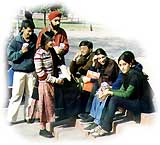 When you enter the classroom, expect a bunch of girls and boys who are as interested as you are in the travel and tourism trade! When you enter the classroom, expect a bunch of girls and boys who are as interested as you are in the travel and tourism trade!
|
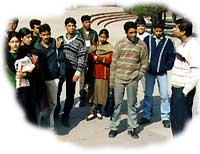 The faculty at TIM are professionals with meritorious track records and years of experience in their specialisations. What makes them distinctive is their passion for their subject.
|
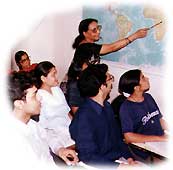 Lectures will be peppered with debates, discussions and seminars. Be prepared to lead occasionally! To turn you into thorough professionals, you will be asked to conduct field investigations, case studies and other project work.
|
|||||
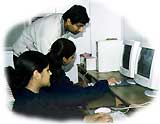 Computer aided training via CD-ROMs adds to making the classroom interactive, informative and as techie as you like it!
|
 Expect to have great interaction with your fellow students in the classroom and outside! TIM generally draws students with exuberant, extroverted personalities. And since each batch is a comfortable number of 20 - 25 students, you get to be a happy close-knit community. We find that a TIM course also does a good bit for the individual's personality development. |
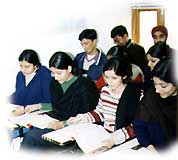 Expect guest lectures from luminaries in the travel, hotel and cargo industry. High profile managers, customer relations and marketing experts. |


 |
Expect to get great value for money. This is important for whoever is paying for the course fee - you, your parents or your organisation. TIM is the only institute of its kind in the country with such extraordinary depth and breadth of experience in the industry. |
+++++
Registration & enrolment
The registration and enrollment is not transferable. Registration and enrollment fees be paid in full when the application is made and must be accompanied with the application form which is attached with the prospectus. Fees once paid is not refunded.
Eligibility
In order to join TIM's diploma courses, the applicant should have successfully completed a higher secondary school or an equivalent education. A good understanding of written English, World Geography and Basic Mathematics is essential.
Registration procedure
The applicant should complete the attached registration form in BLOCK LETTERS indicating the course they wish to join. On completion of the registration formalities, the applicant will be entitled to the Course Material.
Enrolment procedure
Once the registration formalities are completed, the applicant should then fill in the enrollment form giving the complete details along with 3 passport size photographs . The enrollment fees will include complete course material for the course enrolled and two examination attempts per paper.
After enrollment the applicant will initially receive the compulsory module book - "Customer Relations and Marketing Skills". Subsequently, the applicant will receive the respective student material depending upon the course chosen.
Rules & Regulations
Students should attend classes regularly in order to derive full benefit from the course. Students will have to attend at least 75% of the classes in order to qualify for receiving their Diploma Certificate. Students are required to take prior permission in writing or submit an attested leave certificate for the days absent.
Batch timing
Even though the batch time will be specified, students will be required to attend practicals and guest lectures at a different venue and timings. However all efforts will be made to organize practicals during the announced batch time.
Students are expected to arrive 10 minutes before the commencement of the session. In case they are late by more than 20 minutes they will not be allowed to attend the session.
Transfers
Transfers are available from one center to the other in case the student is compelled to relocate. Transfers are permitted only after the completion of module. The admittance / admission at the new location would be from the beginning of the next module. In case of transfers, the receiving center would try to accommodate the student in the desired time slot but the same would be subject to availability and cannot be guaranteed. In case of transfer, a student should pay a fees of Rs 250/- to the Head Office-Mumbai, along with transfer request form.
Validity
Registration is valid upto 6 months from the date of completion of the course. The examination papers have to be cleared within this period. Students having pending term beyond this validity period will have to seek re-admission if they desire to complete the course.
+++++
Examination procedure
Students who enroll for TIM's diploma courses have to pass written examination. However the assessment of the students will be conducted on a continuous basis, giving due weightage to class participation, reports and projects.
When a student is unable to appear in a scheduled internal evaluation test or complete project reports due to illness or emergency, a written application should be given to the Branch Manager within 7 days of the examination. For a re-test, the Branch Manager on verification of the application will decide whether it should be granted or not.
Grading system
For the evaluation purposes, a 6 point grade system will be used. The grade and its corresponding percentages are shown below:
O OUTSTANDING 75-100
A VERY GOOD 65-74
B GOOD 55-64
C+ AVERAGE 50-54
Certification
All enrollments are deemed cancelled and complete on issue of the Diploma Certificate. For issuance of duplicate certificate, a fee of Rs 150/- would be charged. You will be awarded a Diploma, like the one shown here:
My neighbor here in Baltimore graduated from the Trade Wings Institute of Management. She was a great resource whenever I was planning to do something in Washington DC. She worked as a concierge at the Four Seasons Hotel and knew all the tricks to get hard to find tickets etc. Then she decided to move to Washington DC after landing a plum of a job at the Four Seasons located on the edge of Rock Creek Park in D.C.'s chic Georgetown neighborhood. I didn't realize until she told me that every concierge at the hotel is a member of Les Clefs d'Or, the prestigious concierge organization with just 3,000 members worldwide. Wow, little did I know. She is one classy person to have as a friend.